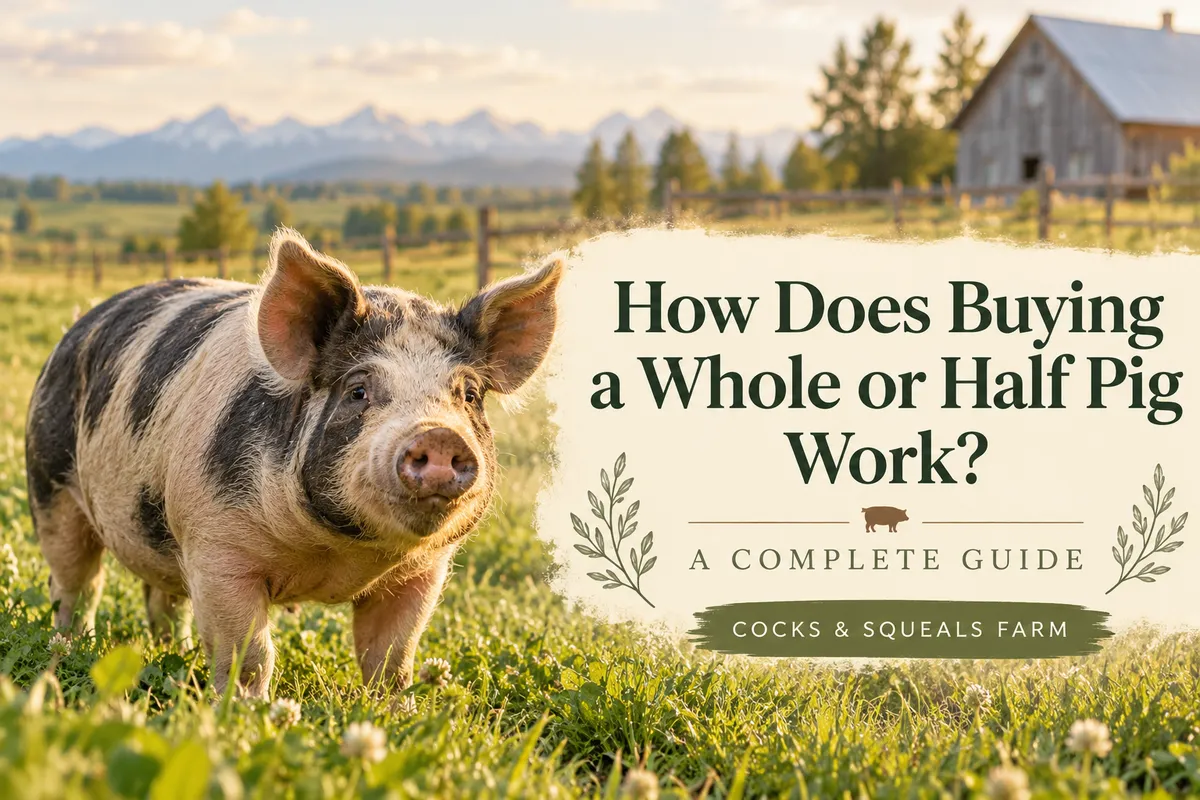
How Does Buying a Whole or Half Pig Work? A Complete Guide
How Does Buying a Whole or Half Pig Work? A Complete Guide
Thinking about buying a whole or half pig directly from a farm, but not quite sure how it works? You're not alone.
If you've always purchased pork by the package at the grocery store, buying half a pig might sound a little intimidating. What's hanging weight? How much meat will you actually get? Can you choose your cuts? And how does the butcher fit into everything?
The good news is that the process is fairly straightforward once you understand a few basics.
At Cocks & Squeals Farm, we believe buying your meat directly from the farmer should be an enjoyable experience, not a confusing one. So we're breaking down how it all works, from choosing a whole or half hog to filling your freezer with locally raised pork.
1. What's the Difference Between Buying a Whole and Half Pig?
When you buy a whole pig, you're purchasing the meat from the entire animal. When you buy half a pig, you're purchasing one side of the animal.
It's as simple as that.
Both options give you access to a variety of pork cuts, including chops, roasts, ribs, shoulder, belly, and ham.
A half pig might be right for you if:
You're new to buying meat in bulk.
You have a smaller household.
You want a good variety of cuts without committing to an entire animal.
You have limited freezer space.
A whole pig might be right for you if:
You have a larger family or eat pork regularly.
You want to stock your freezer for an extended period.
You enjoy cooking a variety of cuts.
You want more flexibility when choosing how your pork is processed.
Neither option is necessarily better. It really comes down to how much pork your household eats and how much freezer space you have available.
2. What Is Hanging Weight, and Why Does It Matter?
This is probably the most important thing to understand when purchasing a whole or half hog.
Most farms selling pork in bulk use something called hanging weight to calculate the purchase price.
But hanging weight is not the same as the amount of packaged meat you'll take home.
There are actually three different weights to understand.
Live Weight
This is how much the pig weighs while it's still alive, before going to the butcher.
For example, a market-ready pig might weigh 250 pounds.
Hanging Weight
After slaughter, the internal organs, blood, and certain other parts are removed. The remaining carcass is weighed, giving us the hanging weight.
Depending on the slaughter and dressing method, the hanging weight is often approximately 70–75% of the pig's live weight.
For example:
Live pig: 250 lb
Hanging weight: approximately 175–188 lb
Half-hog hanging weight: approximately 88–94 lb
These are examples, not guaranteed weights. Every pig is different.
Packaged Weight
Once the butcher finishes cutting and preparing the pork, you'll have your final packaged weight.
This will be less than the hanging weight because additional bone, excess fat, and other trim may be removed during processing.
The important thing to remember is that you're generally paying for hanging weight, not the final weight of the packages in your freezer.
That can be confusing the first time you purchase meat in bulk, but it's a normal part of how whole and half animals are sold.
3. How Much Meat Do You Actually Get From Half a Pig?
Now for the question everyone really wants answered: how much pork will end up in my freezer?
A commonly used estimate is that you'll take home approximately 65–75% of the hanging weight as packaged pork, although your actual yield can fall outside this range.
Let's use a pig with a 200-pound hanging weight as an example.
Whole Pig | Half Pig | |
|---|---|---|
Hanging weight | 200 lb | 100 lb |
Estimated packaged pork | 130–150 lb | 65–75 lb |
These estimates assume a typical mix of cuts. Your final yield depends on the size of the animal, how it is dressed, how much bone and fat you retain, and which cuts you select.
For example, choosing bone-in roasts or keeping the pork belly can change the final weight compared with selecting mostly boneless cuts.
And remember, even the parts that don't become familiar grocery-store cuts may have other uses, depending on the processing options available.
4. How Much Does Buying a Whole or Half Pig Cost?
When purchasing pork directly from a farm, it's important to understand that there can be two main components to the total cost.
The Cost of the Pig
The farm's charge is commonly based on the hanging weight of the animal.
For example, if you're purchasing half a pig with a hanging weight of 100 pounds, the calculation would be:
100 lb × the farm's price per pound of hanging weight = your pork purchase cost
The actual weight is normally confirmed after slaughter, so the final cost may differ from an initial estimate.
Butcher and Processing Costs
The second component is the cost of turning that carcass into the cuts you'll bring home.
Depending on the butcher and your chosen options, processing charges may include:
Slaughter and initial preparation
Cutting and wrapping
Grinding pork
Making sausage
Curing and smoking bacon or ham
Additional specialty cuts or packaging requests
Some butchers charge a basic processing rate and add fees for certain services. Others have different pricing structures.
For example, if you want your pork belly made into bacon, there may be additional charges for curing, smoking, and slicing.
The same can apply to turning ground pork into sausage.
Before purchasing, always make sure you understand whether butcher fees are included in the farm's price or billed separately.
At Cocks & Squeals Farm, we'll explain the applicable pricing and processing arrangements before customers commit to an order. Final options and charges will depend on the inspected processor handling our pork.
5. What Is a Pork Cut Sheet, and How Do You Choose Your Cuts?
One of the best parts about buying a whole or half pig is having a say in what ends up in your freezer.
That's where a cut sheet comes in.
A cut sheet is essentially a set of instructions telling the butcher how you'd like your pork prepared.
Rather than having every cut selected for you, you may have the opportunity to customize your order based on how your family likes to eat.
Here are some common options.
Pork Chops and Loin
The loin is where pork chops come from.
Depending on the processor, you may be able to choose:
Bone-in or boneless pork chops
Chop thickness
Number of chops per package
Loin roasts instead of some chops
Keep in mind that choosing more loin roasts means fewer pork chops from that same section of the animal.
Pork Shoulder
Shoulder is a versatile cut, especially if you enjoy pulled pork.
You might choose shoulder roasts, steaks, or to have some of the meat ground.
If you've ever made slow-cooked pulled pork, you'll know why keeping a shoulder roast is worth considering.
Pork Belly and Bacon
Yes, bacon comes from the belly!
Depending on available processing services, you may be able to keep your belly fresh or have it cured, smoked, and sliced into bacon.
Keep in mind that bacon processing often comes with additional charges.
Ham
The hind leg of the pig provides the ham.
You may be able to choose between fresh pork roasts, cured and smoked ham, or other preparations.
A fresh ham is simply an uncured cut of pork. It won't taste like the familiar cured ham you buy at the grocery store unless it goes through that additional processing.
Ribs
Depending on how the carcass is cut, you may receive spare ribs, back ribs, or other rib portions.
Some cuts compete with others. For example, selecting certain boneless loin cuts can affect how the back ribs are prepared.
Ground Pork and Sausage
Any suitable meat that isn't being kept as roasts, chops, or other cuts can potentially be used for ground pork.
Depending on the butcher, you may also have the option of turning some into sausage.
This can be particularly handy for quick weeknight meals.
Do You Have to Know Exactly What You Want?
Absolutely not.
If you've never completed a cut sheet, it can look like a lot of decisions.
A good starting point is to think about what your household already cooks.
Love breakfast bacon and pork chops? Prefer slow-cooker roasts? Use a lot of ground meat?
Those preferences can guide your choices.
The exact cut-sheet options available will depend on the processor, and not every cut or specialty product can be selected independently. We'll provide guidance on the available process once our butcher arrangements are finalized.
6. How Much Freezer Space Do You Need for Half a Pig?
Before ordering a whole or half pig, make sure you've got somewhere to store it!
As a general planning guideline, allow approximately one cubic foot of usable freezer space for every 30–35 pounds of packaged meat. This leaves some room to organize packages rather than squeezing everything in.
Using the example from earlier:
Purchase | Estimated Packaged Pork | Suggested Freezer Space |
|---|---|---|
Half pig | 65–75 lb | 3–4 cu. ft. |
Whole pig | 130–150 lb | 5–6 cu. ft. |
These are planning estimates, not exact requirements. Package shapes, box sizes, freezer design, and the amount of other food already stored will all affect how much room you need.
A dedicated chest freezer is often a practical option for families purchasing meat in bulk.
And here's a tip: once your pork arrives, organize the packages by cut.
Keeping your chops, roasts, ground pork, and bacon in separate sections makes meal planning much easier.
There's nothing quite like digging through a freezer looking for pork chops and coming up with six packages of sausage instead.
7. How Does the Ordering and Processing Process Work?
While every farm handles orders a little differently, buying bulk pork generally follows a few steps.
Step 1: Reserve Your Pork
Start by contacting the farm or joining its reservation list.
Because raising pigs takes time, whole and half hog purchases are often arranged well before the animals are ready for processing.
Some farms require deposits to confirm reservations, while others handle payments differently.
Step 2: The Pig Goes for Processing
When the animal is ready, it is transported for slaughter and processing.
For meat sold in Alberta, the applicable inspection requirements must be met. Meat sold to customers must come through inspected slaughter and processing arrangements.
The carcass is weighed, establishing the hanging weight used to calculate the farm's charge when pricing is based on that weight.
Step 3: Complete Your Cut Sheet
The processor or farm provides instructions for choosing your preferred cuts.
Depending on the arrangement, the cut sheet may be completed before or around the scheduled processing date.
This is when you'll decide what you want from your share of the pig, subject to the available options.
Step 4: Your Pork Is Cut and Packaged
The butcher prepares your cuts according to the agreed instructions.
If you've requested bacon, ham, sausage, or other specialty processing, additional steps may be required.
Processing times will vary depending on the butcher's schedule and the services requested.
Step 5: Final Weights and Charges Are Confirmed
Once the relevant weights and services are known, your final charges can be calculated.
You'll be advised of payment and collection arrangements based on the farm and processor's procedures.
Step 6: Bring Your Pork Home
When your order is ready, you'll receive instructions for collecting your packaged pork or any delivery options that have been arranged.
Make sure you've cleared enough freezer space ahead of time.
Then comes the good part: deciding what to cook first!
8. Why Buy Your Pork Directly From Cocks & Squeals Farm?
There are plenty of places to buy pork. So why purchase directly from a small farm?
For us, the answer starts long before the pork reaches your plate.
At Cocks & Squeals Farm, located in Wheatland County near Strathmore, Alberta, we're raising heritage-breed pigs with a focus on quality, responsible animal care, and the way our animals live.
Our pigs are pasture-raised, with opportunities to root, explore, and behave like pigs should.
We also feed a corn- and soy-free ration because we're committed to having control over what goes into raising our animals.
We believe good food starts with good farming practices.
That means paying attention to the animals, their environment, their feed, and their well-being throughout their lives.
We often describe our approach as "Only One Bad Day."
Our goal is to give our animals a good life, treating them with care and respect from the day they arrive until the day they leave the farm.
Buying directly from us also means you know where your pork was raised, who raised it, and the values behind it.
No mystery about where it came from.
Just a family farm working to raise good food for other families.
9. Frequently Asked Questions About Buying a Half or Whole Pig
Is buying half a pig cheaper than grocery-store pork?
It depends.
Buying in bulk can offer value, particularly if your family enjoys a variety of cuts. But the total cost also includes processing, and not every cut has the same retail value.
A more useful comparison is to calculate your total cost divided by the pounds of packaged pork you receive, then compare that with the quality and mix of cuts you normally buy.
The biggest benefit isn't necessarily finding the cheapest pork. It's knowing how your food was raised and having a freezer stocked with meat you feel good about feeding your family.
Can I request only certain cuts?
You can often customize many cuts, but you can't turn an entire half pig into bacon or pork chops.
Each animal has a limited amount of loin, belly, shoulder, and other sections.
Your cut sheet lets you choose how the available meat is prepared, rather than changing how much of each part exists.
Can I buy a quarter pig instead?
Some farms offer smaller pork boxes or packages, but a quarter pig isn't as straightforward as a half.
A half hog is one side of the animal, giving you a share of the major cuts. Dividing that side again doesn't automatically give everyone the same variety.
Smaller pork purchasing options may be available separately from whole and half hog orders.
Do I need to contact the butcher myself?
That depends on the farm and the processor.
Some farms coordinate everything, while others have customers work directly with the butcher on cut sheets and processing charges.
It's worth asking who you'll be communicating with before confirming your order.
How long will the pork last in my freezer?
When properly packaged and stored at -18°C (0°F) or colder, fresh pork can maintain excellent quality for 8–12 months, and potentially longer with good freezer packaging.
Vacuum-sealed packaging helps protect against freezer burn and preserves flavour and texture by limiting exposure to air.
While pork kept continuously frozen at the proper temperature remains safe indefinitely, its quality may gradually decline. Ground pork, bacon, and sausage generally have shorter recommended storage times than chops and roasts.
For the best results, keep your freezer at a consistent temperature, label your packages with the freezing date, and use older cuts first.
The bottom line? With proper packaging and storage, buying a whole or half hog is a practical way to stock your freezer with quality pork for many months to come.
Is the meat packaged and ready for the freezer?
Bulk pork is typically cut and wrapped or vacuum-sealed by the processor.
Confirm the packaging and freezing arrangements with your farm or butcher before collection so you know exactly what to expect.
When should I order my pork?
Earlier is usually better.
Small farms raise a limited number of animals, and processing appointments need to be arranged in advance.
If you're interested in purchasing heritage pork from Cocks & Squeals Farm, joining our waitlist is a good way to hear about upcoming availability before our first processing season.
10. Ready to Fill Your Freezer With Farm-Raised Pork?
Buying a whole or half pig might seem complicated at first, but once you understand hanging weight, processing fees, and cut sheets, it's really a straightforward way to purchase meat directly from the people raising it.
And there's something pretty satisfying about opening your freezer and knowing exactly where your food came from.
At Cocks & Squeals Farm, we offer whole and half heritage hogs raised on pasture, fed our corn- and soy-free ration, and cared for with the welfare of the animal in mind.
If you'd like to be among the first to hear about reservations, availability, and purchasing details, we'd love to have you on our waitlist.
Join the Cocks & Squeals Farm pork waitlist and get 10% off your first order up to $25.